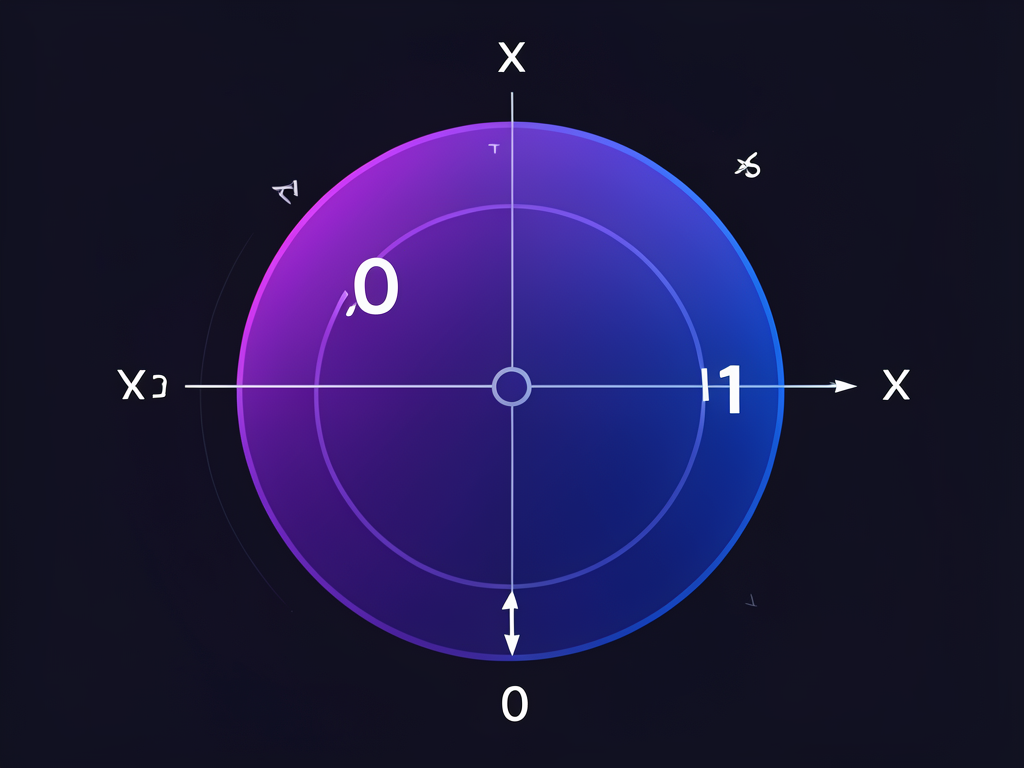
What is a qubit? (No, it's not a bit that's 0 and 1 at the same time)
The most misunderstood concept in computing, explained without the mysticism. A qubit is weirder than '0 and 1 simultaneously' — and more useful.
Every article about quantum computing starts the same way: “A classical bit is 0 or 1. A qubit can be 0 and 1 at the same time.”
This is technically not wrong, but it’s misleading in a way that makes everything else confusing. Let’s fix it.
Start with what you know
A classical bit is like a coin lying on a table. It’s heads or tails. You look at it, and it’s one or the other. Simple.
A qubit is more like a coin that’s been flipped and is spinning in the air. While it’s spinning, it’s not heads, and it’s not tails. It has some tendency toward each — maybe it was flipped with a slight bias toward heads. But until it lands, it’s genuinely neither.
When you “measure” a qubit, the coin lands. You get a definite answer: heads or tails, 0 or 1. And once it’s landed, it’s just a regular bit.
Why “0 and 1 at the same time” is misleading
If qubits were just “0 and 1 at the same time,” a quantum computer would be like a regular computer that tries both answers at once. That would be useful — but that’s not what happens.
The key difference: a qubit has a hidden property that regular coins don’t. It doesn’t just have a probability of being 0 or 1. It has an amplitude for each.
Amplitudes are like probabilities, but they can be negative. And negative amplitudes can cancel positive ones out.
This is the whole trick.
The coin analogy, extended
Imagine you flip two coins that are somehow connected (we’ll get to how later). Each coin is spinning in the air with its own tendencies.
In a normal world, the odds of both landing heads would just be: (chance of coin 1 heads) × (chance of coin 2 heads). Independent probabilities multiply.
But in the quantum world, the tendencies (amplitudes) of the two coins can interfere with each other. Some combinations become more likely. Others become impossible — not because the coins can’t land that way, but because the amplitudes for those outcomes cancel to zero.
This is like throwing two stones into a pond. Each creates ripples. Where the ripples meet, some spots get bigger waves (constructive interference) and some spots go flat (destructive interference). Quantum computing is about arranging the ripples so the answer you want gets a big wave, and everything else cancels out.
So what can you actually do with this?
Not everything. In fact, quantum computers are slower than regular computers for most tasks. They’re worse at spreadsheets, web browsing, word processing — basically everything you do every day.
But for specific problems — simulating molecules, searching structured databases, breaking certain encryption, optimising complex systems — the interference trick gives you a genuine shortcut. Not because you’re trying all answers at once, but because you’re using physics to make wrong answers cancel out.
The notation (worth learning)
Physicists write qubit states using “ket” notation: |0⟩ and |1⟩. The vertical bar and angle bracket are just decoration — |0⟩ means “the state where you’d measure 0” and |1⟩ means “the state where you’d measure 1.”
A qubit in superposition is written:
|ψ⟩ = α|0⟩ + β|1⟩
This says: the qubit (called ψ, pronounced “psi”) has amplitude α for being measured as 0, and amplitude β for being measured as 1.
The rules:
- α and β are the amplitudes — they can be positive, negative, or even complex numbers
- |α|² gives the probability of measuring 0, and |β|² gives the probability of measuring 1
- |α|² + |β|² = 1 always — the probabilities have to add up to 100%
So a qubit with equal tendency toward 0 and 1 would be written:
|ψ⟩ = (1/√2)|0⟩ + (1/√2)|1⟩
Because (1/√2)² + (1/√2)² = ½ + ½ = 1. If you measure it, you get 0 or 1 with 50/50 probability.
This notation will appear in other articles on this site. Now you can read it.
The honest summary
- A qubit is a system that has some tendency toward 0 and some toward 1, expressed as amplitudes (not just probabilities)
- Amplitudes can be negative, which means they can cancel each other out
- Quantum computing works by arranging amplitudes so the right answer survives and wrong answers destructively interfere
- When you measure, you get a definite classical answer — the quantum magic is in what happens before measurement
- This only helps for certain types of problems, not all of them
If someone tells you quantum computers “try all possibilities simultaneously,” ask them: “Then why can’t they do everything faster?” The answer reveals the real story — it’s about interference, not parallelism.
What’s next?
Now that you understand qubits, the next concept to grasp is entanglement — how qubits can be connected in ways that classical systems can’t replicate. It’s less mystical than it sounds.